Vyrenoqexar
Align Asset
Align Asset
Couldn't load pickup availability
- ⬇️ Digital file available after purchase
- 🗂️ Long-term availability
- 🔒 Secure checkout
- 🗓️ Content updated in 2026
Self-paced learning overview
Share
Problem Statement
Monitoring can reveal unusual activity, control changes, and emerging behavior patterns, but teams still need a clear process for deciding what those observations mean. In AI-enabled environments, one event may involve several components, including user input, data routes, instruction layers, permissions, model responses, connected services, and human review.
Without an organized incident preparation process, records may remain disconnected, responsibilities may be unclear, and important details may be missed during later analysis.
Solution
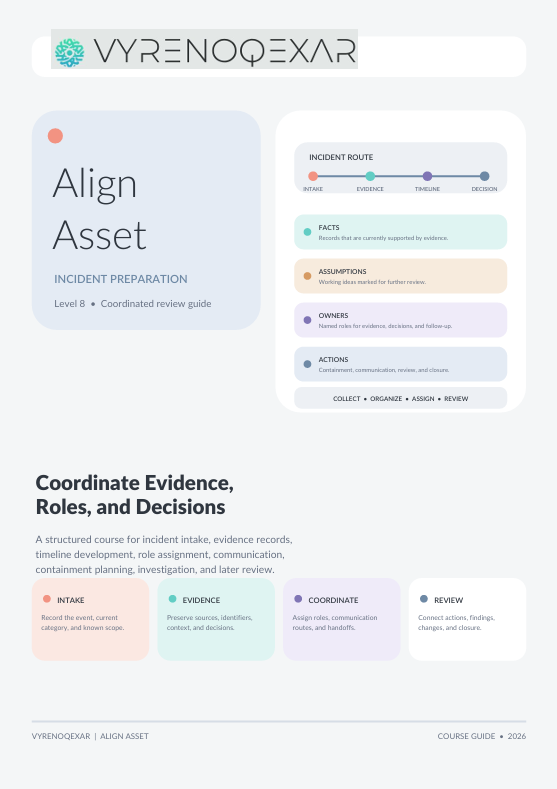
This tier helps learners organize the steps that support a clear response to unusual or unwanted system behavior. The lessons cover event intake, initial classification, evidence records, responsibility assignment, communication routes, containment planning, and post-event review.
Learners examine how monitoring observations can be converted into structured incident records. They also study how teams can separate confirmed facts from assumptions, maintain a clear timeline, and connect each response action to a defined defensive objective.
What’s Inside
Align Asset includes structured lessons, incident record templates, timeline-building activities, evidence tables, role-mapping worksheets, containment scenarios, review checklists, knowledge checks, and summary materials.
Topics include:
- Incident preparation
- Event intake and classification
- Evidence documentation
- Timeline development
- Role assignment
- Communication routes
- Containment planning
- Decision records
- Recovery considerations
- Post-event review
- Documentation consistency
- Defensive process updates
Who Is This For?
This tier is intended for learners who understand AI system monitoring, defensive controls, and architectural review.
It may be useful for:
- Security learners studying incident procedures
- Developers involved in defensive review
- Analysts organizing event records
- Technical teams defining response responsibilities
- Documentation specialists preparing incident materials
- Learners progressing toward broader defensive coordination
What You’ll Learn
- Convert monitoring observations into structured incident records
- Separate confirmed information from working assumptions
- Classify events using defined review categories
- Build a clear timeline of relevant system activity
- Identify evidence sources across connected components
- Assign technical and human review responsibilities
- Design communication and escalation routes
- Document containment decisions and their purpose
- Record changes made during an incident review
- Connect events to earlier threats, controls, and tests
- Prepare information for recovery planning
- Conduct a structured post-event review
Enrollment and Refund Terms
Align Asset includes a 30-day refund request period. Requests are considered according to the conditions described in the store’s published refund policy.
Certification
The course includes a certificate of completion, giving learners a clear way to record their completion of the required lessons, incident activities, and defensive review exercises.
What materials are included?
What materials are included?
Each tier contains structured lessons, topic explanations, practical examples, guided activities, review questions, and reference materials related to AI security and defensive engineering.
Do I need prior security knowledge?
Do I need prior security knowledge?
The opening tiers introduce core terminology and defensive principles. Later tiers build on those foundations and explore more detailed analysis, testing, architecture, and response planning.
Are the tiers arranged in a learning sequence?
Are the tiers arranged in a learning sequence?
Yes. The tiers move from introductory AI security concepts toward broader defensive engineering topics. Learners may follow the full sequence or select materials that match their current knowledge.