Vyrenoqexar
Axis Module
Axis Module
Couldn't load pickup availability
- ⬇️ Digital file available after purchase
- 🗂️ Long-term availability
- 🔒 Secure checkout
- 🗓️ Content updated in 2026
Self-paced learning overview
Share
Problem Statement
Threat models describe where security concerns may develop, but they do not always explain how those concerns should be examined through controlled testing. AI-enabled systems can respond differently depending on input structure, instruction order, data context, user role, and connected components. Without a clear testing method, observations may become inconsistent or difficult to compare.
Solution
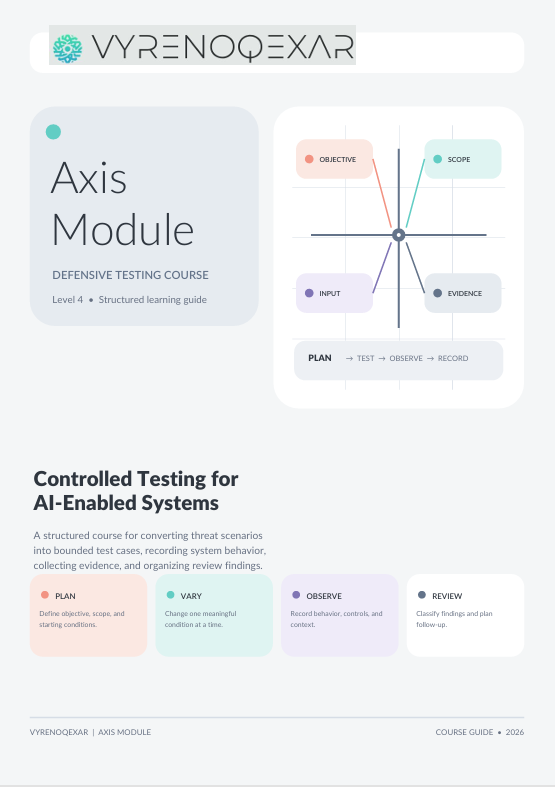
This tier presents defensive testing as a repeatable process built around planning, observation, documentation, and review. Learners study how to convert threat scenarios into focused test cases and how to separate normal system behavior from responses that require closer analysis.
The lessons cover test objectives, starting conditions, input variation, response review, evidence collection, and result classification. Learners also examine why testing should be conducted within defined boundaries and supported by clear records.
What’s Inside
Axis Module contains structured lessons, test-planning templates, guided scenarios, behavior review tables, evidence-recording worksheets, response classification activities, knowledge checks, and summary materials.
The course explores:
- Defensive testing objectives
- Test scope and boundaries
- Starting conditions and assumptions
- Input and instruction variation
- Expected and unexpected behavior
- Evidence collection
- Result classification
- Repeat testing
- Review notes
- Responsible testing practices
Learners complete guided activities that demonstrate how small changes in inputs or system context can affect observed behavior.
Who Is This For?
This tier is intended for learners who understand introductory AI security concepts, system mapping, and basic threat modeling.
It may be useful for:
- Developers reviewing AI-enabled features
- Security learners studying defensive testing
- Analysts examining system responses
- Technical team members preparing review procedures
- Documentation specialists recording security findings
- Learners moving toward control design and defensive architecture
What You’ll Learn
- Convert threat scenarios into structured test cases
- Define clear testing objectives and boundaries
- Record starting conditions before testing begins
- Develop input variations for controlled review
- Compare expected behavior with observed responses
- Identify responses that require further examination
- Collect and organize testing evidence
- Classify findings using consistent categories
- Repeat tests while maintaining comparable conditions
- Document assumptions and testing constraints
- Connect test findings to specific system components
Enrollment and Refund Terms
Axis Module includes a 30-day refund request period. Requests are reviewed according to the conditions stated in the store’s published refund policy.
Certification
The course includes a certificate of completion, giving learners a clear way to record their completion of the required lessons, testing activities, and review exercises.
What materials are included?
What materials are included?
Each tier contains structured lessons, topic explanations, practical examples, guided activities, review questions, and reference materials related to AI security and defensive engineering.
Do I need prior security knowledge?
Do I need prior security knowledge?
The opening tiers introduce core terminology and defensive principles. Later tiers build on those foundations and explore more detailed analysis, testing, architecture, and response planning.
Are the tiers arranged in a learning sequence?
Are the tiers arranged in a learning sequence?
Yes. The tiers move from introductory AI security concepts toward broader defensive engineering topics. Learners may follow the full sequence or select materials that match their current knowledge.